

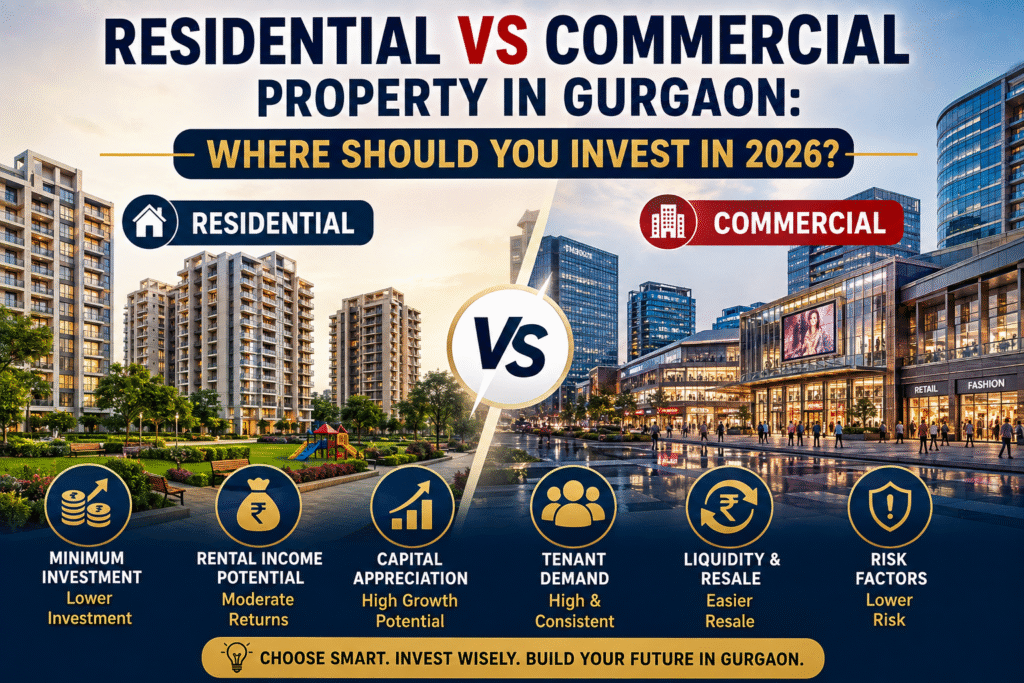
💰 Residential vs Commercial Property in Gurgaon: Where Should You Invest in 2026?
Gurgaon has evolved into one of India’s most important real estate and corporate destinations. From luxury residences and high-rise apartments to premium office spaces, retail shops and commercial projects, investors today have more options than ever.
But this also creates an important question:
Should you invest in residential property or commercial property in Gurgaon in 2026?
The answer depends on your budget, investment objective, risk appetite and holding period.
If your priority is easier entry, broader tenant demand and relatively better liquidity, residential property may be the better choice.
If your priority is higher rental income and long-term cash flow, commercial property can be more attractive—but usually comes with higher entry costs and greater vacancy and asset-selection risk.
Gurugram’s market remains strong in 2026. The city saw 51 RERA-approved projects during the first half of the year, covering 16,727 units across residential, commercial and industrial categories, indicating continued developer and investor activity.
Let’s compare both options in detail.
Residential vs Commercial Property: Quick Comparison
| Factor | Residential Property | Commercial Property |
|---|---|---|
| Entry Investment | Generally lower | Generally higher |
| Rental Yield | Usually lower | Usually higher |
| Tenant Demand | Broad and consistent | Depends heavily on location |
| Capital Appreciation | Strong in growth corridors | Can be strong in prime locations |
| Liquidity | Relatively higher | Can be lower |
| Lease Period | Usually shorter | Often longer |
| Vacancy Risk | Generally moderate | Can be significant if the asset is poorly located |
| Management | Relatively simple | More complex |
| Best For | First-time investors & end-users | Experienced & income-focused investors |
These are broad market characteristics, not guaranteed returns. Actual performance varies by project, location, property type and purchase price.
🏠 Residential Property in Gurgaon
Residential real estate includes apartments, builder floors, villas, plots and luxury residences.
Gurgaon’s residential market has benefited from strong employment demand, infrastructure development and increasing interest in premium housing.
In 2026, Gurugram continues to attract substantial residential activity. Recent market data shows strong demand for premium housing, while new supply remains concentrated in major growth corridors.
Why Invest in Residential Property?
1. Lower Entry Barrier
Residential properties generally offer a wider range of investment budgets.
An investor can consider:
1 BHK or studio units
2 BHK apartments
3 BHK apartments
Builder floors
Plots
Luxury apartments
Villas
This makes residential property more accessible to first-time investors.
2. Strong End-User Demand
Unlike some commercial assets that depend heavily on business activity, residential properties have a large underlying pool of end-users.
Gurgaon attracts:
IT professionals
Corporate executives
Entrepreneurs
MNC employees
Business owners
NRIs
Families relocating to Delhi-NCR
This creates continuous demand for quality housing in well-connected locations.
3. Better Flexibility
A residential property gives an investor several options.
You can:
Live in it → Rent it → Resell it → Hold it for appreciation
This flexibility can be particularly useful for first-time investors.
💰 What About Residential Rental Income?
Rental income is one of the biggest differences between residential and commercial property.
Residential rental yields in Gurgaon are generally lower than commercial yields. Some 2026 market analyses put typical residential gross yields around 2–4%, depending on location and property type, although individual properties can vary considerably.
For example, suppose an apartment costs:
₹2 crore
and generates:
₹60,000/month rent
Annual rent:
₹60,000 × 12 = ₹7.2 lakh
Gross rental yield:
₹7.2 lakh ÷ ₹2 crore × 100 = 3.6%
But remember that actual net yield will be lower after maintenance, vacancy, repairs and other ownership costs.
Therefore, residential property in Gurgaon is generally more of a capital appreciation + moderate rental income investment rather than a pure rental-yield investment.
📈 Residential Capital Appreciation
Capital appreciation is one of the strongest reasons investors choose residential property in Gurgaon.
Locations benefiting from infrastructure and employment growth can experience significant appreciation over time.
Important residential corridors include:
Dwarka Expressway
Strong infrastructure-led development and connectivity to Delhi and the airport region.
Golf Course Extension Road
Established premium residential ecosystem with strong end-user and rental demand.
SPR
A strategic growth corridor connecting several major parts of Gurgaon.
New Gurgaon
A relatively accessible market for first-time and mid-budget investors.
Sohna Road
An established residential corridor with continued development potential.
Sector 70–80 Belt
A strategic area benefiting from connectivity to several important Gurgaon corridors.
The important point is that capital appreciation is highly project-specific. Buying in a good corridor does not automatically guarantee good returns.
🏢 Commercial Property in Gurgaon
Commercial real estate includes:
Retail shops
High-street shops
SCO properties
Office spaces
Managed office spaces
Commercial floors
Food & beverage spaces
Commercial plots
Gurgaon has a structural advantage in commercial real estate because of its large corporate ecosystem.
The city’s office market has continued expanding, supporting demand for commercial spaces and the surrounding residential ecosystem.
💵 Why Commercial Property Can Generate Higher Rental Income
Commercial properties generally offer higher rental yields than residential properties.
Depending on location, format, tenant profile and occupancy, 2026 market estimates commonly place commercial rental yields around 6–10%, with some prime or specialised assets potentially higher.
For example:
Suppose a commercial unit costs:
₹2 crore
and generates:
₹1.2 lakh/month rent
Annual rent:
₹1.2 lakh × 12 = ₹14.4 lakh
Gross rental yield:
₹14.4 lakh ÷ ₹2 crore × 100 = 7.2%
This illustrates why commercial property is attractive to investors focused primarily on cash flow.
However, investors should never assume that every commercial property will generate 7–10% returns.
Location, footfall, occupancy, tenant quality, lease terms and purchase price matter enormously.
👥 Commercial Tenant Demand
Commercial properties can attract:
Retail brands
Restaurants
Cafés
Clinics
Banks
Corporate offices
Startups
Service businesses
Local retailers
Franchise operators
But tenant demand is more location-sensitive than residential demand.
A residential apartment in a good neighbourhood may find tenants relatively easily.
A commercial shop in a poorly planned project may remain vacant for months or even years.
Therefore:
For commercial real estate, location is not just important—it can determine the entire investment outcome.
📊 Commercial Property and Long-Term Leases
Another major advantage of commercial real estate can be longer lease commitments.
Depending on the asset and tenant, commercial leases can run for several years and may include lock-in periods and periodic rent escalations.
This can provide investors with greater income visibility compared with typical residential leases.
However, longer leases also mean that investors need to carefully evaluate:
Tenant quality
Lock-in period
Escalation clause
Security deposit
Maintenance obligations
Exit clauses
CAM charges
Property taxes
Fit-out responsibilities
A high headline rent does not necessarily mean a high net return.
🔄 Liquidity: Which Is Easier to Sell?
This is another major difference.
Residential
Residential property generally has a larger buyer pool because buyers include both:
End-users
Investors
A good apartment in an established Gurgaon location can therefore be relatively easier to resell.
Commercial
Commercial property has a narrower buyer pool.
A buyer will often evaluate:
Rent + Yield + Tenant + Lease + Location + Future Appreciation
This makes commercial resale more dependent on the property’s financial performance.
Therefore:
Residential → Generally better liquidity
Commercial → Potentially higher income but potentially lower liquidity
⚠️ Risk Factors: Residential vs Commercial
No real estate investment is risk-free.
Residential Risks
1. Low Rental Yield
Even a high-value apartment may generate relatively modest rental income compared with its purchase price.
2. High Purchase Price
Gurgaon’s premium residential prices have increased significantly, which can reduce rental yield for new investors.
3. Maintenance Costs
Luxury projects can have substantial maintenance and common-area charges.
4. Construction/Delivery Risk
Under-construction projects can involve possession delays and additional holding costs.
Commercial Property Risks
1. Vacancy Risk
A commercial unit can remain vacant for an extended period if there is insufficient footfall or business demand.
2. Higher Entry Cost
Prime commercial assets can require substantially more capital.
3. Location Risk
A property inside a project with poor accessibility or low footfall may struggle even when the overall Gurgaon market is performing well.
4. Tenant Risk
The quality of the tenant directly affects income stability.
5. Higher Complexity
Commercial investment requires greater attention to lease agreements, maintenance charges, tenant obligations and operating costs.
🏆 Residential vs Commercial: Which Has Better ROI?
There is no universal answer.
But the two asset classes typically produce returns in different ways.
Residential Investment Model
Capital Appreciation + Moderate Rental Income
Residential is generally more suitable if your objective is long-term wealth creation and you want a property with broader resale and end-use flexibility.
Commercial Investment Model
Rental Income + Capital Appreciation
Commercial can be more attractive when the objective is generating regular cash flow from the asset.
Some 2026 market analyses estimate commercial yields around 6–10% versus roughly 2–4% for residential, but these are broad ranges and should not be treated as guaranteed returns.
👨💼 Who Should Invest in Residential Property?
Residential may be the better choice if you are:
A First-Time Investor
If this is your first real estate investment, residential property can be easier to understand and manage.
Looking for Better Liquidity
If you may need to sell the property in the future, residential generally offers a broader buyer pool.
Planning to Use the Property
You can eventually move into the property yourself.
Investing for Long-Term Appreciation
If your holding period is 5–10 years, a well-selected residential property in a growing Gurgaon corridor can potentially benefit from infrastructure and employment growth.
🏢 Who Should Invest in Commercial Property?
Commercial property may be better suited to you if:
You Want Higher Rental Income
Commercial assets can generate significantly higher rental yields than typical residential properties.
You Have Higher Investment Capital
Commercial property generally requires more capital and financial planning.
You Understand Tenant & Lease Management
You should be comfortable evaluating tenants, lease structures and operating expenses.
You Want Cash Flow
Investors seeking regular rental income may find commercial property more attractive.
You Have a Longer Investment Horizon
Commercial investments often work best when the investor is willing to hold the property through market cycles.
📍 Which Gurgaon Locations Suit Each Investor?
For Residential Investors
Consider established and emerging residential corridors such as:
Dwarka Expressway
Golf Course Extension Road
New Gurgaon
SPR
Sohna Road
Sector 70–80
The ideal location depends on whether you prioritise affordability, rental demand, premium positioning or future appreciation.
For Commercial Investors
Look for commercial opportunities around:
Golf Course Extension Road
SPR
Dwarka Expressway
New Gurgaon
Golf Course Road
Established business districts
High-footfall retail locations
For commercial property, don’t simply ask:
“Which area is appreciating?”
Ask:
“Where will businesses actually want to operate?”
🧮 Example: ₹2 Crore Investment
Let’s simplify the comparison.
Option A – Residential
Investment:
₹2 crore
Potential gross rental yield:
2.5–4%
Potential annual rent:
₹5–8 lakh
Main objective:
Capital appreciation + rental income
Option B – Commercial
Investment:
₹2 crore
Potential gross rental yield:
6–10%
Potential annual rent:
₹12–20 lakh
Main objective:
Rental cash flow + capital appreciation
These figures are illustrative market ranges—not promises. Actual rent, vacancy, maintenance and appreciation can produce substantially different outcomes.
🔥 The Biggest Mistake Investors Make
Many investors compare properties only on:
“How much rent will I get?”
That’s not enough.
Instead, calculate:
Total ROI = Rental Income + Capital Appreciation − Costs
Your costs may include:
Stamp duty
Registration
GST where applicable
Brokerage
Maintenance
Property tax
Vacancy
Repairs
Financing costs
Leasing expenses
Exit costs
A property offering a 9% headline rental yield may not necessarily outperform a residential property once vacancy and operating expenses are considered.
🏁 Final Verdict: Residential or Commercial in Gurgaon in 2026?
The right answer depends on what you want your property to do for you.
Choose Residential if you want:
✔ Lower entry barrier
✔ Larger tenant/end-user pool
✔ Better flexibility
✔ Easier resale in many cases
✔ Long-term capital appreciation
✔ Option to use the property yourself
Choose Commercial if you want:
✔ Higher potential rental income
✔ Longer lease structures
✔ Regular cash flow
✔ Business-driven demand
✔ Potentially higher income-oriented returns
For a first-time investor with a moderate budget, residential property is often the easier starting point.
For an experienced investor with higher capital and a focus on rental cash flow, commercial property can be more attractive.
And for investors with a larger portfolio, there is another strategy:
Don’t necessarily choose one. Build a diversified real estate portfolio with both residential and commercial assets.
Conclusion
Gurgaon’s 2026 real estate market offers opportunities across both residential and commercial segments.
Residential property remains attractive for investors looking for long-term appreciation, flexibility and a broader buyer/tenant base.
Commercial property stands out for investors seeking higher rental income and cash-flow potential, but it requires more careful analysis of location, tenant demand, lease terms and vacancy risk.
The most important rule is:
Don’t buy a property simply because the projected ROI looks high. Buy an asset where the location, demand, developer, pricing and exit strategy make sense together.
Before investing, compare at least three to five comparable properties, calculate the total acquisition cost, verify RERA and title-related details, understand the rental market and assess your expected holding period.
In Gurgaon, the best investment is not necessarily the property with the highest advertised return—it is the property that delivers the best risk-adjusted return for your financial goals.
Disclaimer: Real estate returns are market- and property-specific and are not guaranteed. Rental yields and appreciation figures mentioned above are indicative ranges based on market analyses and can vary significantly by project, location, property type, tenant profile and purchase price. Investors should independently verify approvals, RERA registration, title, charges, lease terms and financial assumptions before investing.