

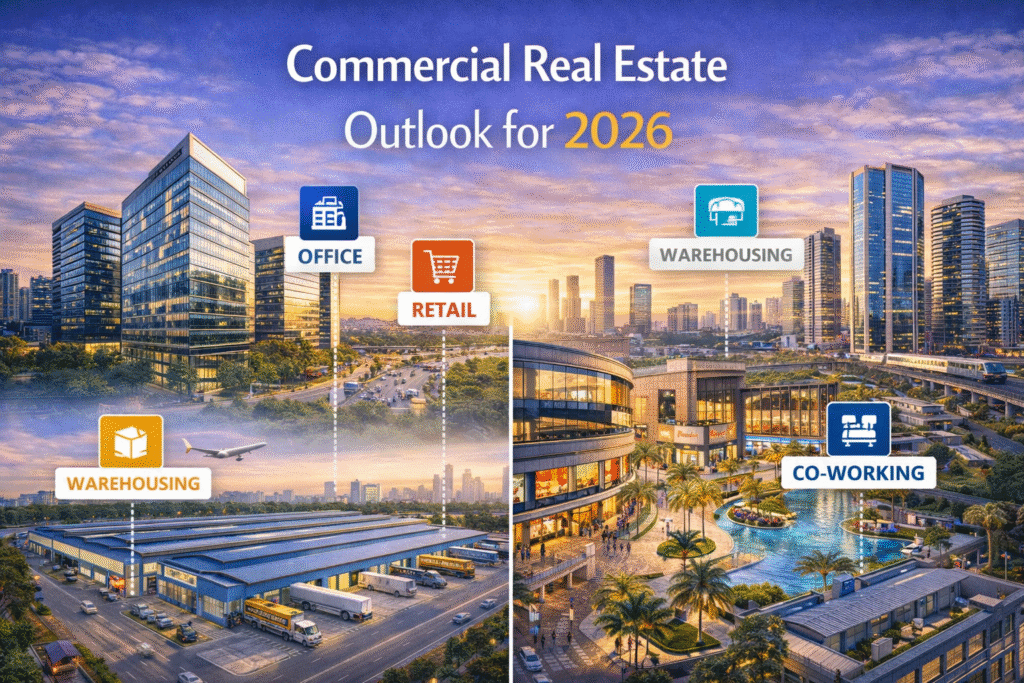
Commercial Real Estate Outlook for 2026: Growth, Opportunities & Key Trends
The commercial real estate sector in India is entering a strong growth phase in 2026. Driven by economic expansion, rising corporate demand, infrastructure upgrades, and evolving work patterns, commercial assets are attracting renewed interest from investors, developers, and occupiers.
From office spaces and retail hubs to mixed-use developments, let’s explore the commercial real estate outlook for 2026 and what it means for investors and businesses.
1. Office Space Demand Remains Strong
Despite the rise of hybrid work models, office real estate continues to perform well in 2026.
Key drivers:
Expansion of IT, tech, and global capability centers (GCCs)
India’s cost advantage for multinational companies
Demand for Grade A office spaces
Focus on employee-centric workplaces
Companies are prioritizing quality offices in prime locations rather than just reducing space.
2. Rise of Global Capability Centers (GCCs)
One of the biggest growth catalysts in 2026 is the expansion of GCCs.
Multinationals are setting up large captive centers in India
Demand for premium office campuses is rising
Long-term leasing improves occupancy stability
Cities like Bengaluru, Hyderabad, Pune, Gurgaon, and Chennai continue to benefit.
3. Retail Real Estate Making a Strong Comeback
Retail real estate has rebounded strongly post-pandemic.
Trends shaping retail in 2026:
Experiential shopping over pure retail
Growth of high-street retail
Demand for organized malls in urban & Tier-2 cities
F&B and entertainment driving footfall
Retail spaces in mixed-use developments are especially attractive.
4. Warehousing & Logistics on the Fast Track
E-commerce growth and supply-chain optimization are fueling warehousing and logistics real estate.
Key growth drivers:
Rising online shopping
Same-day and next-day delivery demand
Industrial corridor development
Improved highway connectivity
This segment offers stable long-term leases and attractive yields.
5. Co-Working & Flexible Office Spaces Evolve
Flexible workspaces are no longer just for startups.
In 2026:
Enterprises are adopting managed office solutions
Demand for flexible leasing models is increasing
Co-working spaces are expanding in secondary business districts
This segment adds resilience to the office market.
6. Infrastructure-Led Commercial Growth
Infrastructure continues to be a major value driver.
Commercial assets near:
Metro corridors
Expressways
Airports
Central business districts
are seeing higher demand, better rentals, and stronger appreciation.
7. Investor Interest & Rental Yields
Commercial real estate remains attractive for investors due to:
Higher rental yields compared to residential
Long-term leases
Corporate-backed tenants
Predictable cash flows
In 2026, well-located commercial assets continue to outperform many traditional investment options.
8. REITs Strengthen Market Confidence
Real Estate Investment Trusts (REITs) are adding transparency and liquidity.
Benefits include:
Professional asset management
Stable income distribution
Increased institutional participation
REITs are helping commercial real estate mature into a more organized asset class.
9. Tier-2 Cities Enter the Commercial Spotlight
Beyond metros, Tier-2 cities are gaining attention.
Why?
Lower rentals and operating costs
Growing talent pool
Government support and infrastructure development
This opens new opportunities for long-term investors.
Commercial Real Estate Outlook 2026: At a Glance
| Segment | Outlook for 2026 |
|---|---|
| Office Spaces | Strong & stable |
| Retail | High growth |
| Warehousing | Very strong |
| Co-working | Expanding |
| Mixed-use | High demand |
Final Thoughts
The commercial real estate outlook for 2026 remains highly positive. With strong occupier demand, infrastructure growth, and increasing investor confidence, commercial assets are set to deliver stable income, long-term appreciation, and portfolio diversification.
For investors seeking higher yields and predictable cash flows, commercial real estate in 2026 offers compelling opportunities—especially when backed by the right location, asset quality, and tenant profile.