

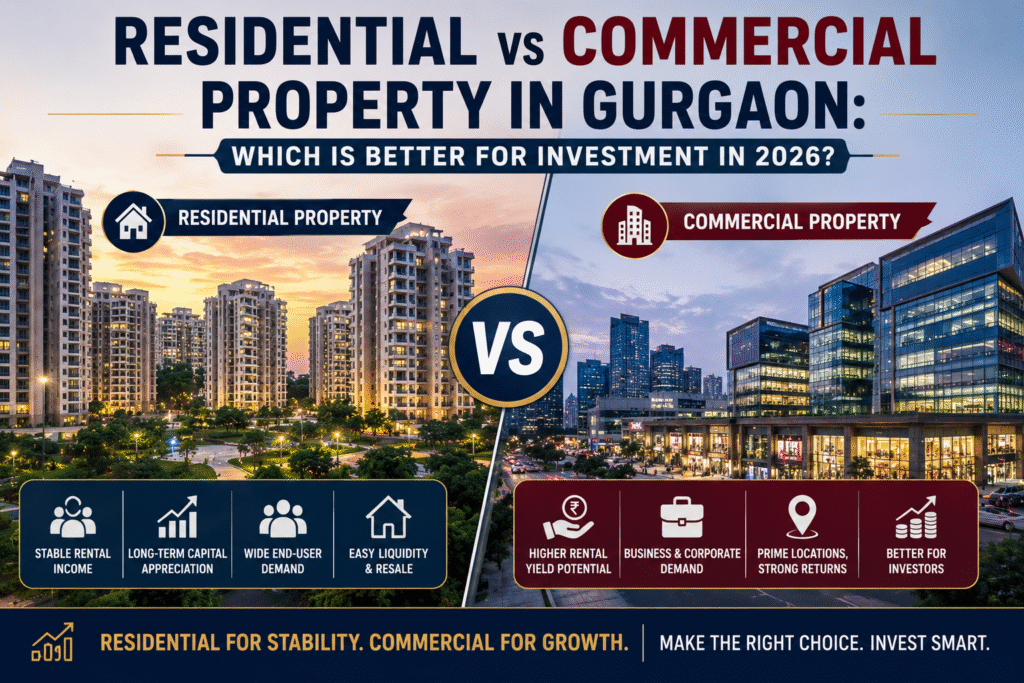
Residential vs Commercial Property in Gurgaon: Which Is Better for Investment in 2026?
Gurgaon, officially Gurugram, has become one of India’s most important real estate markets. With a strong corporate ecosystem, expanding infrastructure, premium residential developments, office hubs, retail destinations and growing rental demand, the city offers investors a wide range of property investment opportunities.
But for someone planning to invest in Gurgaon in 2026, one important question often comes up:
Should you invest in residential property or commercial property?
The answer depends on several factors, including your investment budget, expected rental income, risk appetite, investment horizon, liquidity requirements and long-term financial objectives.
Residential property may offer a broader end-user market and relatively familiar ownership model, while commercial property can offer attractive income opportunities when the location, tenant profile and asset quality are strong.
In this guide, we compare residential vs commercial property in Gurgaon across the factors that matter most to investors.
Gurgaon Real Estate in 2026: Why the Comparison Matters
Gurgaon’s real estate market continues to benefit from strong economic and infrastructure fundamentals.
The city’s office market is supported by demand from global capability centres, technology companies and domestic businesses. India’s office market recorded its strongest-ever first-half absorption in 2026, according to CBRE, while Delhi-NCR remained one of the leading office markets.
Residential real estate is also seeing strong momentum. Recent reporting based on market data showed substantial residential price appreciation in Gurgaon, with infrastructure development contributing to growth in several corridors.
This means both residential and commercial real estate deserve consideration—but they serve different investment purposes.
Residential vs Commercial Property: At a Glance
| Factor | Residential Property | Commercial Property |
|---|---|---|
| Entry Investment | Generally more flexible | Often higher, depending on asset |
| Rental Potential | Moderate to strong depending on location | Can be higher, but varies significantly |
| Tenant Profile | Families, professionals, students | Businesses, retailers, brands, offices |
| Capital Appreciation | Strong in growth corridors | Strong for quality assets in prime locations |
| Liquidity | Usually broader end-user market | Can be more asset-specific |
| Vacancy Risk | Generally diversified demand | Can be significant if location/tenant demand is weak |
| Management | Relatively straightforward | Can require more active management |
| Risk | Moderate, depending on property | Can be higher due to tenant and business risk |
| Best For | End-users + long-term investors | Income-focused and experienced investors |
The table provides a broad framework. Actual performance depends heavily on the specific property, location, developer, pricing and market conditions.
1. Entry-Level Investment Requirements
One of the first factors investors consider is the amount of capital required.
Residential Property
Residential investment in Gurgaon covers a wide range of options, including:
Apartments
Builder floors
Luxury residences
Plots
Independent houses
Affordable and mid-segment housing
Because the residential market has multiple segments, investors can choose properties according to their available budget.
For many first-time investors, residential property can therefore be easier to understand and evaluate.
Commercial Property
Commercial property includes:
Retail shops
High-street retail
Office spaces
Food and beverage units
Commercial floors
Mixed-use developments
The investment amount can vary significantly depending on location, size, project and asset type.
Commercial properties in established business locations may require substantially more capital than some residential options.
Which Is Better?
For investors with a smaller or moderate budget, residential property may provide more flexibility.
Commercial property can become attractive when the investor has sufficient capital and is comfortable evaluating rental and business-related risks.
2. Rental Income Comparison
Rental income is one of the biggest reasons investors consider real estate.
Residential Rental Income
Gurgaon has a large tenant base consisting of:
Corporate professionals
Executives
Families
Students
Entrepreneurs
Expatriates
Properties located near corporate hubs, metro connectivity, major roads, schools, hospitals and lifestyle destinations can attract stronger tenant demand.
Residential rental income can therefore provide relatively consistent cash flow in well-established micro-markets.
However, investors should calculate net rental yield, not simply monthly rent.
Consider:
Maintenance charges
Property management
Vacancy periods
Repairs
Taxes
Financing costs
before determining the actual return.
Commercial Rental Income
Commercial properties can potentially generate stronger rental income, but the outcome is highly dependent on:
Location
Footfall
Tenant quality
Lease structure
Occupancy
Property type
Business activity
Nearby competition
A well-located commercial property with a strong tenant can be an attractive income-generating asset.
However, an unoccupied shop or office can create significant carrying costs.
Which Is Better?
Commercial property can offer stronger rental-income potential, but residential property may offer a broader and more predictable tenant pool in many locations.
The actual yield must be calculated property by property.
3. Capital Appreciation
Capital appreciation refers to the increase in the property’s market value over time.
Gurgaon has several infrastructure-led growth corridors where connectivity improvements and urban expansion are supporting real estate demand.
Recent 2026 reporting highlighted significant residential price increases in parts of Gurgaon, including areas benefiting from infrastructure upgrades.
Residential Appreciation
Residential properties can benefit from:
Population growth
Employment growth
Infrastructure development
New connectivity
Social infrastructure
Limited availability in established locations
Growing end-user demand
Locations such as Dwarka Expressway, Golf Course Extension Road, SPR, New Gurgaon and other developing corridors are frequently evaluated by residential investors.
Commercial Appreciation
Commercial properties can appreciate when:
Business activity increases
Footfall grows
Rental values rise
Vacancy falls
New infrastructure improves accessibility
The surrounding residential population increases
For example, a retail asset located within a growing residential catchment may benefit from increasing consumer demand.
Which Is Better?
There is no universal winner.
A prime commercial property can outperform a weak residential investment, while a well-located residential property can outperform an oversupplied commercial project.
Location and asset quality matter more than the residential-vs-commercial label.
4. Liquidity and Resale
Liquidity means how easily an investment can be sold without significantly compromising on price.
Residential Property
Residential property generally has a broad potential buyer pool:
End-users
Investors
Families
First-time buyers
NRIs
This can support resale demand, particularly for properties in established locations.
Commercial Property
Commercial resale depends heavily on the asset’s income potential.
A property with:
Strong rental income
Reliable tenant
Good lease terms
High footfall
Prime location
can attract investors.
However, an underperforming commercial unit may take longer to sell.
Which Is Better?
For many investors, residential property offers broader resale demand.
Commercial property can still be highly liquid when the asset has strong income fundamentals.
5. Risk Factors
Every real estate investment involves risk.
The key is understanding what type of risk you are taking.
Residential Property Risks
Common risks include:
Property price fluctuations
Vacancy
Maintenance expenses
Delayed possession in under-construction projects
Oversupply in certain micro-markets
Financing costs
However, residential properties generally have a large end-user market.
Commercial Property Risks
Commercial investments can involve additional risks:
Tenant vacancy
Business failure
Longer vacancy periods
Changing consumer behaviour
High competition between commercial projects
Dependence on footfall
Lease-related risks
Higher maintenance or common-area charges
For retail properties in particular, the location and actual footfall can be more important than the project’s marketing claims.
Which Is Safer?
There is no risk-free category.
Residential may be more suitable for conservative or first-time investors, while commercial can suit investors who understand tenant, lease and location dynamics.
6. Who Should Choose Residential Property?
Residential property may be suitable for you if:
You Are a First-Time Investor
Residential property is generally easier to understand and compare.
You Want a Broader Buyer Market
Homes have a large end-user market.
You Want Rental Income
A well-located residential property can generate recurring rental income.
You Want Long-Term Appreciation
Residential property in a growing micro-market can benefit from infrastructure and population growth.
You May Need to Sell in the Future
A wider end-user market can potentially support resale liquidity.
7. Who Should Choose Commercial Property?
Commercial property may be suitable if:
Your Primary Objective Is Rental Income
Income-focused investors may find commercial assets attractive when tenant demand is strong.
You Have Higher Investment Capital
Commercial assets can require significant upfront investment depending on the location and asset type.
You Understand Business Locations
You should be comfortable evaluating:
Footfall
Tenant profile
Lease terms
Vacancy
Rental rates
Competition
You Have a Higher Risk Appetite
Commercial property performance can vary considerably from one project to another.
You Want Portfolio Diversification
Experienced investors may use commercial property to diversify an existing residential portfolio.
8. What About Commercial Property Investment in Gurgaon in 2026?
The broader commercial real estate environment remains significant in 2026.
According to CBRE, India’s office market recorded approximately 45.5 million sq. ft. of absorption in H1 2026, the highest half-yearly level recorded, while Delhi-NCR was among the major contributors to office leasing activity.
This supports the broader investment case for quality commercial real estate in major employment hubs.
However, investors should remember that office demand does not automatically mean every commercial property will perform well.
Commercial property is highly location-specific.
An investor should examine:
Actual occupancy
Tenant demand
Nearby businesses
Accessibility
Parking
Visibility
Footfall
Lease structure
Maintenance charges
Developer reputation
Competing supply
before investing.
9. Long-Term Investment Strategy
Instead of choosing residential or commercial purely based on expected returns, investors should build a strategy around their financial objectives.
Strategy 1: Conservative Investor
Focus on:
Established residential location + strong end-user demand + rental potential
This can be appropriate for investors prioritising stability and familiarity.
Strategy 2: Income-Focused Investor
Consider:
Quality commercial property + strong tenant demand + sustainable rental income
The focus should be on actual income fundamentals rather than advertised returns.
Strategy 3: Growth Investor
Consider:
Emerging infrastructure corridor + long investment horizon + strong developer
The objective is to benefit from potential capital appreciation as the location develops.
Strategy 4: Diversified Investor
Experienced investors can consider a combination of:
Residential + Commercial
This can spread exposure across different demand drivers.
10. How to Calculate Real Estate Returns
Do not evaluate a property only on its purchase price.
Consider the complete investment:
Total Investment = Purchase Price + Registration + Taxes + Brokerage + Other Costs
For rental property, evaluate:
Net Rental Yield = Annual Net Rental Income ÷ Total Investment Cost × 100
For capital appreciation, compare:
Capital Gain = Selling Price − Total Acquisition Cost
Also consider the holding period, financing cost and taxes when evaluating the overall return.
A property promising a high headline return may not deliver the same result after all costs are included.
Residential vs Commercial Property Gurgaon: Which Is Better?
The answer depends on the investor.
Choose Residential If You Want:
Broader buyer demand
Relatively familiar investment
Potential rental income
Long-term residential appreciation
Lower complexity for your first investment
Choose Commercial If You Want:
Potentially higher rental income
Income-oriented investment
Exposure to business-driven demand
Portfolio diversification
A longer-term commercial investment strategy
Consider Both If:
You already have real estate exposure and want to diversify across residential and commercial assets.
What Should You Check Before Buying?
Regardless of the property type, investors should conduct proper due diligence.
1. Location
Check existing and upcoming connectivity, employment hubs and social infrastructure.
2. Developer
Review the developer’s track record and delivery history.
3. Legal Documentation
Verify title, approvals, project documentation and applicable RERA information.
4. Pricing
Compare the property with similar assets in the surrounding micro-market.
5. Rental Data
Look at actual market rents rather than relying only on projected returns.
6. Supply
Understand how many competing residential or commercial projects are coming up nearby.
7. Exit Strategy
Always consider:
Who will buy this property from me in the future?
A good investment should have a realistic exit strategy.
Best Property Investment in Gurgaon 2026: Residential or Commercial?
There is no single property type that is best for everyone.
The best property investment in Gurgaon in 2026 is the one that matches:
Your Budget + Investment Horizon + Risk Profile + Income Objective + Location + Exit Strategy
For a first-time investor seeking a relatively straightforward investment, residential property may be the more comfortable choice.
For an experienced investor seeking rental income and willing to evaluate tenant and commercial risks, commercial property may be more suitable.
And for investors with sufficient capital and a diversified portfolio, a combination of both can be worth considering.
Final Verdict
So, residential vs commercial property in Gurgaon—which is better?
The answer is:
Residential is not automatically better. Commercial is not automatically better. The right property is better.
Gurgaon’s continued economic activity, infrastructure development and real estate demand create opportunities across both segments.
The 2026 market also highlights why investors should focus on quality over hype. Strong office leasing nationally and continued residential price growth provide a supportive backdrop, but individual projects can perform very differently.
Before investing, compare the location, developer, pricing, rental potential, supply, legal status and exit opportunities.
Looking to Invest in Gurgaon?
Sapphirre Realty helps investors and homebuyers explore residential and commercial property opportunities across Gurgaon and Delhi-NCR.
Whether you are looking for a luxury residence, an investment apartment, a commercial shop, office space or a long-term real estate opportunity, the right strategy starts with understanding your investment objective.
Sapphirre Realty – Invest Smart
Premium Residential & Commercial Real Estate Consultancy
Gurgaon | Delhi-NCR
Your Concern, Our Priority.