

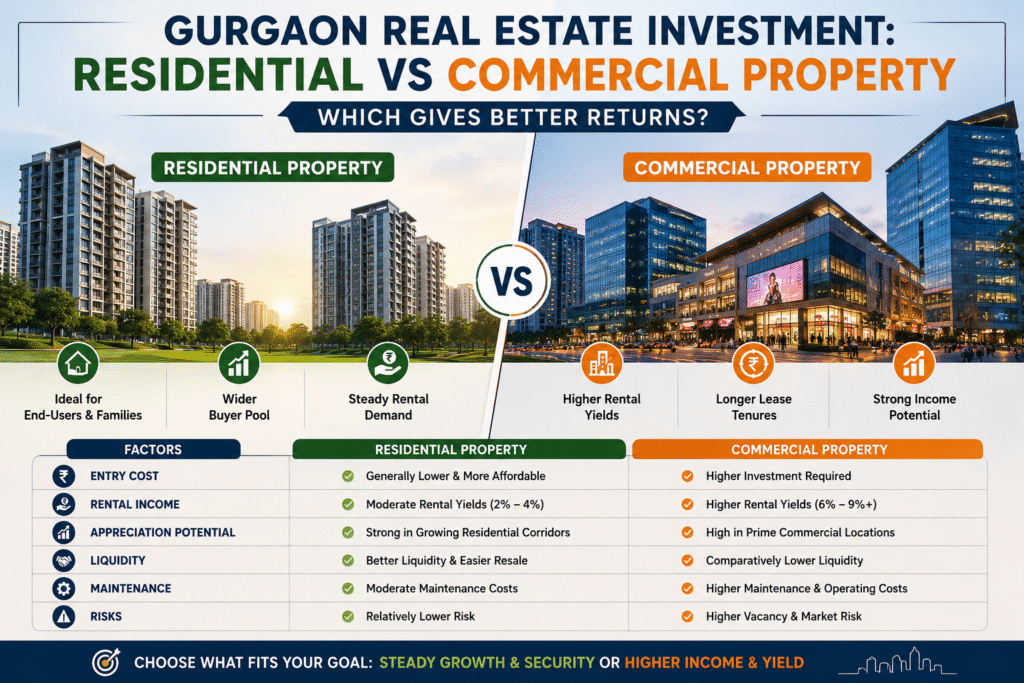
Gurgaon Real Estate Investment: Residential vs Commercial Property — Which Gives Better Returns?
Gurgaon, now officially Gurugram, has become one of India’s most attractive real estate investment destinations. With major corporate offices, multinational companies, improved infrastructure, expanding metro connectivity, and growing residential demand, the city offers opportunities across both residential and commercial real estate.
But for an investor in 2026, an important question remains:
Should you invest in residential property or commercial property in Gurgaon?
The answer depends on your budget, investment horizon, risk appetite, rental-income expectations, and objective. While residential properties generally offer broader end-user demand and easier resale, commercial properties can provide higher rental yields and stronger income potential.
Let’s compare both asset classes across the factors that matter most to investors.
Residential vs Commercial Property in Gurgaon: At a Glance
| Factor | Residential Property | Commercial Property |
|---|---|---|
| Entry Cost | Generally more accessible | Usually higher, depending on asset |
| Rental Yield | Moderate | Potentially higher |
| Capital Appreciation | Strong in developing corridors | Strong in prime commercial locations |
| Tenant Demand | Broad | More dependent on business activity |
| Liquidity | Generally better | Can be lower for specialised assets |
| Maintenance | Moderate | Can be higher |
| Vacancy Risk | Relatively manageable | Can be significant |
| Lease Stability | Usually shorter | Often longer leases |
| Investor Profile | End-users & conservative investors | Income-focused investors |
| Risk Level | Moderate | Moderate to high |
1. Entry Cost: Which Is More Affordable?
One of the first factors investors consider is the initial investment required.
Residential Property
Gurgaon offers residential properties across a wide range of budgets. Investors can consider apartments, builder floors, plotted developments, and luxury residences depending on their financial capacity.
Emerging areas such as New Gurgaon, Sohna Road and parts of Dwarka Expressway can provide comparatively varied entry points.
Residential property can therefore be suitable for investors who want to enter the Gurgaon market without committing an extremely large amount of capital.
Commercial Property
Commercial real estate can require a significantly higher investment, particularly for prime office spaces, high-street retail, and premium commercial projects.
However, commercial investment isn’t limited to large offices. Investors can also explore:
- Retail shops
- Office spaces
- SCO plots
- High-street commercial
- Food & beverage spaces
- Managed office spaces
- Small commercial units
The important point is that lower ticket size does not automatically mean better investment. Investors need to evaluate the location, footfall, tenant profile, developer, maintenance charges and exit potential.
Winner for affordability: Residential
2. Rental Income: Commercial Usually Has the Edge
If your primary objective is regular rental income, commercial property can have an advantage.
Prime commercial locations in Gurgaon benefit from demand generated by corporate offices, retail activity, restaurants, healthcare, education and other businesses.
Commercial leases can also be longer than typical residential leases, potentially providing greater income visibility.
Residential properties, on the other hand, generally have a larger tenant pool. Gurgaon attracts professionals from across India, creating continuous demand for rental homes in locations close to employment hubs.
However, residential rental yields are usually lower than the potential yields available from a well-performing commercial asset.
Example
Suppose an investor purchases:
Residential property: ₹1.5 crore
Annual rent: ₹4.5 lakh
Gross rental yield: approximately 3%
Now consider:
Commercial property: ₹1.5 crore
Annual rent: ₹9 lakh
Gross rental yield: approximately 6%
These numbers are purely illustrative. Actual rental yields vary significantly by project, location, property type, occupancy and purchase price.
Winner for rental yield: Commercial
3. Capital Appreciation: Location Matters More Than Property Type
When it comes to appreciation, it is difficult to declare a universal winner.
A residential property in a rapidly developing corridor can outperform an older commercial property in a weak location.
Similarly, a strategically located commercial property with strong tenant demand can appreciate significantly.
In Gurgaon, investors should watch infrastructure-led corridors such as:
- Dwarka Expressway
- Golf Course Extension Road
- Southern Peripheral Road
- New Gurgaon
- Sohna Road
- Golf Course Road
- Manesar
The most important factors are connectivity, employment generation, infrastructure, supply-demand balance and future development.
Residential appreciation
Residential appreciation can be particularly strong when new infrastructure attracts homebuyers and investors.
Commercial appreciation
Commercial appreciation can benefit from increasing rentals, business activity, footfall and limited availability of prime commercial locations.
Winner: Depends on location and project quality
4. Liquidity: Residential Usually Has a Wider Buyer Pool
Liquidity means how easily you can sell your property without significantly compromising on price.
Residential properties generally have a wider buyer base because they can be purchased by:
- End-users
- Families
- Investors
- NRIs
- First-time buyers
- Rental investors
Commercial properties can have a narrower buyer pool, especially when the asset is highly specialised or dependent on a particular tenant or business model.
For example, a well-located residential apartment may be easier to resell than a specialised commercial unit with limited tenant demand.
However, prime commercial assets in established business locations can also have strong resale demand.
Winner for broad liquidity: Residential
5. Maintenance and Operating Costs
Property ownership involves more than the purchase price.
Residential
Residential owners generally deal with:
- Maintenance charges
- Property tax
- Repairs
- Society charges
- Insurance
- Vacancy periods
These costs are often relatively predictable.
Commercial
Commercial property can involve:
- Higher maintenance charges
- Common-area expenses
- Property tax
- Fit-out requirements
- Brokerage
- Vacancy costs
- Repair and refurbishment expenses
For retail and office properties, the condition and presentation of the property can have a direct impact on tenant demand.
Therefore, investors should calculate net rental yield, not just gross rental yield.
Winner: Residential
6. Vacancy Risk: A Major Factor for Commercial Investors
A commercial property may offer higher rental income, but it can also come with greater vacancy risk.
Imagine a commercial unit generating ₹1 lakh per month in rent.
If it remains vacant for six months, the investor loses ₹6 lakh in potential rental income while still potentially paying maintenance and other expenses.
Residential properties can also experience vacancies, but Gurgaon has a large rental population consisting of professionals, families and students, depending on the location.
Commercial vacancy risk therefore needs particularly careful evaluation.
Before buying commercial property, ask:
Who will rent this property?
If you cannot identify a realistic tenant profile, the projected rental yield may not mean much.
Winner for lower vacancy risk: Residential
7. Lease Period and Rental Stability
Commercial properties often have longer lease structures than residential properties.
A good commercial tenant may sign a multi-year agreement, giving the investor greater rental visibility.
Residential tenants typically have shorter agreements and may move because of:
- Job transfers
- Family changes
- Better rental options
- Lifestyle preferences
- Relocation
This means commercial property can potentially provide greater rental stability when the property has a strong tenant and location.
However, a long lease is not automatically beneficial if the rent is below market levels or the property becomes difficult to re-lease after the tenant exits.
Winner: Commercial
8. Risk: Higher Returns Can Come With Higher Complexity
Residential property is often considered easier for first-time investors because the underlying demand is straightforward: people need homes.
Commercial property requires deeper analysis.
You need to understand:
- Footfall
- Tenant profile
- Business viability
- Rental market
- Lease terms
- Lock-in period
- Escalation clauses
- CAM charges
- Vacancy risk
- Developer reputation
- Surrounding competition
This makes commercial real estate potentially more rewarding but also more complex.
Winner for simpler investment: Residential
9. Gurgaon’s Best Residential Investment Strategy
For residential investors, the focus should be on location + connectivity + developer credibility + future infrastructure.
Potential areas to research include:
Dwarka Expressway
Strong infrastructure story and connectivity toward Delhi and the airport.
New Gurgaon
Potentially attractive for investors looking for emerging residential markets and relatively diverse price points.
Golf Course Extension Road
A premium residential market with strong connectivity and established social infrastructure.
SPR
An emerging mixed-use corridor with growing residential and commercial activity.
Sohna Road
An established corridor offering a range of residential options.
The right project matters just as much as the right location.
10. Gurgaon’s Best Commercial Investment Strategy
Commercial investors should focus on rental demand rather than simply buying a property because it is marketed as “high return.”
Before investing, investigate:
1. Actual Footfall
For retail properties, footfall is critical.
2. Occupancy
A project with high occupancy can be more attractive than one filled with vacant units.
3. Existing Tenants
Check the quality and stability of current tenants.
4. Rental Evidence
Don’t rely only on promised rentals. Check actual rents being paid for comparable units.
5. Lease Structure
Understand lock-in periods, escalation clauses, maintenance responsibilities and renewal terms.
6. Location
Commercial real estate is extremely location-sensitive.
A property five minutes away from a major business hub can have very different rental prospects from another property in an isolated development.
Residential vs Commercial: Which Should You Choose?
The answer ultimately depends on your objective.
Choose Residential If:
- You are a first-time real estate investor
- You have a moderate investment budget
- You want a larger tenant pool
- You prioritise resale liquidity
- You prefer comparatively simpler property management
- Your primary objective is long-term appreciation
Choose Commercial If:
- Your priority is rental income
- You have a higher risk appetite
- You understand commercial leasing
- You can handle vacancy periods
- You are comfortable with higher maintenance/operating costs
- You are investing for long-term cash flow
A Simple Investor Example
Consider an investor with a ₹2 crore budget.
Option A: Residential
The investor purchases a ₹2 crore apartment.
If the property generates ₹60,000–₹70,000 monthly rent, the annual gross rental income could be around ₹7.2–₹8.4 lakh.
The investor may benefit from:
Rental income + capital appreciation + broader resale demand
Option B: Commercial
The investor purchases a ₹2 crore commercial property.
Suppose it generates ₹1.2 lakh monthly rent.
Annual gross rental income would be ₹14.4 lakh.
That looks significantly better on paper.
But the investor must also consider:
- Vacancy periods
- Maintenance
- Tenant turnover
- Fit-out costs
- Brokerage
- Commercial market cycles
- Resale liquidity
Therefore, higher rental yield should always be evaluated against higher risk.
What Gives Better Returns in Gurgaon?
There is no one-size-fits-all answer.
If your definition of return is rental income, commercial property may have an advantage.
If your priority is liquidity and simpler ownership, residential property can be more attractive.
If your goal is long-term appreciation, both can perform well when purchased in the right location and at the right valuation.
For many investors, the ideal strategy may actually be a balanced real estate portfolio rather than choosing only one asset class.
For example, an investor could consider residential property for long-term appreciation and later add commercial assets to increase rental income.
Final Verdict
Residential vs commercial real estate is not about which asset class is universally better. It is about which asset class is better for your investment objective.
In Gurgaon, residential real estate remains attractive because of strong end-user demand, expanding infrastructure and the city’s growing population of professionals.
Commercial real estate, meanwhile, can offer stronger rental yields and longer lease opportunities but generally requires more careful due diligence and a greater tolerance for vacancy and market risk.
The smart investor should ask five questions before investing:
1. What is my investment budget?
2. Do I want rental income or capital appreciation?
3. How long can I hold the property?
4. How much vacancy risk can I handle?
5. What is the realistic exit strategy?
Once these questions are answered, choosing between residential and commercial property becomes much easier.
In Gurgaon real estate, the best investment isn’t necessarily the property promising the highest return — it’s the property with the strongest combination of location, fundamentals, rental demand, valuation and exit potential.