

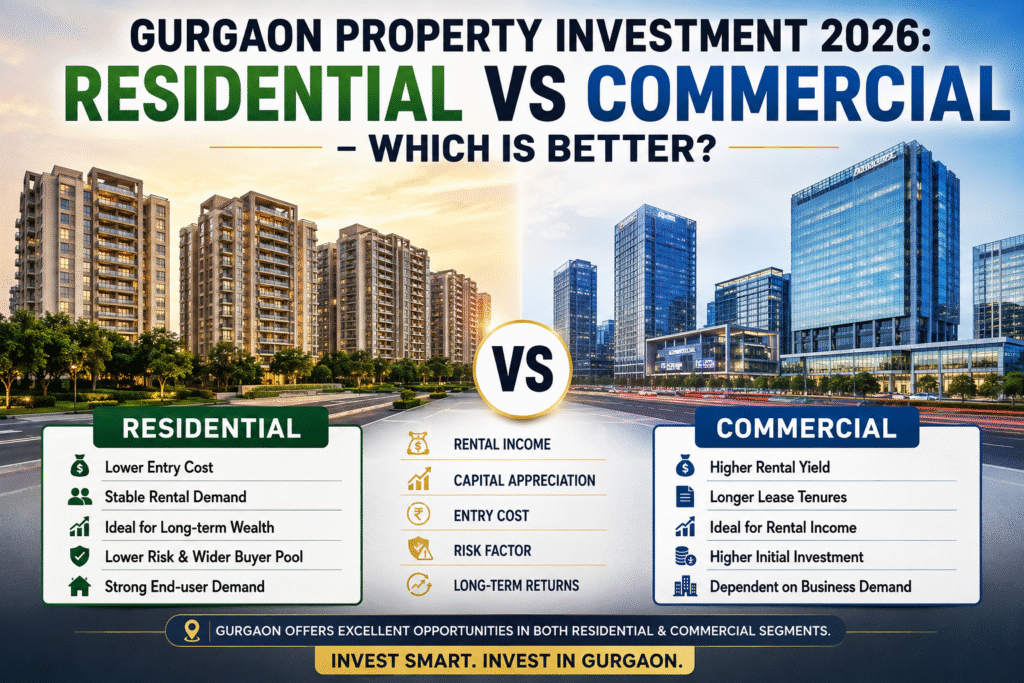
Gurgaon Property Investment 2026: Residential vs Commercial – Which Is Better?
Gurgaon, officially Gurugram, continues to be one of the most attractive real estate markets in Delhi NCR. With expanding corporate activity, new infrastructure, improving connectivity and growing demand for premium housing and commercial spaces, investors have multiple opportunities to participate in the city’s real estate growth.
But one question remains important for investors:
Should you invest in residential or commercial property in Gurgaon in 2026?
Both segments have their advantages. Residential property can offer relatively stable end-user and rental demand, while commercial property can provide higher rental yields and potentially stronger cash flow. However, commercial investments can also involve higher entry costs, vacancy risks and greater dependence on location and tenant quality.
This guide compares residential vs commercial property in Gurgaon across rental income, capital appreciation, entry cost, risk and long-term returns.
Residential vs Commercial Property in Gurgaon: Quick Comparison
| Factor | Residential Property | Commercial Property |
|---|---|---|
| Entry Cost | Generally lower | Generally higher |
| Rental Yield | Moderate | Usually higher |
| Capital Appreciation | Strong in growth corridors | Strong in prime commercial locations |
| Tenant Demand | Broad end-user & rental base | Dependent on businesses and employment |
| Vacancy Risk | Relatively moderate | Can be higher depending on property |
| Management | Comparatively straightforward | May require more active management |
| Liquidity | Usually broader buyer pool | Depends heavily on asset and location |
| Best For | Long-term wealth & stability | Rental income & cash flow |
| Investment Horizon | Medium to long term | Medium to long term |
1. Residential Property Investment in Gurgaon
Residential real estate remains one of the most popular ways to invest in Gurgaon.
The city has a large population of professionals working across IT, consulting, finance, manufacturing, aviation, healthcare and other industries. This creates continuous demand for apartments, luxury residences, builder floors and other housing formats.
Locations such as Dwarka Expressway, Golf Course Road, Golf Course Extension Road, SPR, New Gurgaon and Sohna Road offer different investment opportunities depending on budget and investment horizon.
Why Invest in Residential Property?
Stable End-User Demand
Unlike many commercial assets, residential properties are purchased not only by investors but also by families and individuals looking for homes. This creates a broader potential buyer base.
Rental Demand
Gurgaon’s large working population supports rental demand, particularly around corporate and employment hubs.
Properties located near offices, metro connectivity, highways, schools and retail destinations can have stronger rental potential.
Capital Appreciation
Well-located residential properties can benefit from infrastructure development and increasing land values.
For example, areas surrounding major connectivity corridors can experience increased demand as infrastructure and social amenities develop.
Lower Entry Barrier
Residential property generally offers more options across different price segments. Investors can choose from smaller apartments, mid-segment homes, premium residences or luxury properties depending on their budget.
2. Commercial Property Investment in Gurgaon
Commercial real estate is another major investment opportunity in Gurgaon.
The city has established itself as a major corporate and business destination, with office complexes, retail developments, high-street markets, shopping centres and mixed-use projects spread across multiple corridors.
For investors, commercial property can be attractive because of its potential to generate higher rental income compared with residential property.
Why Consider Commercial Property?
Higher Rental Yield
Commercial properties can potentially generate higher rental yields than residential properties, particularly when located in established business or high-footfall areas.
However, actual returns vary significantly depending on property type, location, tenant, lease terms, maintenance expenses and vacancy periods.
Longer Lease Structures
Commercial tenants may enter into longer lease agreements than typical residential tenants. This can provide investors with greater income visibility when the property is occupied by a quality tenant.
Business Ecosystem
Gurgaon’s large corporate ecosystem creates demand for:
Office spaces
Retail shops
High-street commercial units
Food and beverage spaces
Warehouses and logistics facilities
Mixed-use developments
Potential for Capital Appreciation
Commercial properties in well-established locations can appreciate as surrounding business activity, footfall and infrastructure improve.
However, appreciation is highly asset-specific. A commercial unit in a weak location may not perform as well simply because it is classified as “commercial.”
3. Rental Income: Commercial Has an Advantage
If your primary objective is regular rental income, commercial property can have an advantage.
Residential rental yields in Gurgaon are generally lower compared with the potential yields available from certain commercial assets.
However, investors should not look only at the headline rental yield.
Consider:
Net Rental Return = Annual Rent – Maintenance – Property Expenses – Vacancy Impact
A commercial property offering a high quoted rental yield may still underperform if it experiences long vacancy periods or has high maintenance and operating costs.
Residential
Pros:
Broad tenant pool
Relatively consistent rental demand in good locations
Easier to understand and manage
Suitable for investors seeking stability
Cons:
Lower rental yield in many cases
Tenant turnover can be frequent
Maintenance and furnishing costs can reduce net returns
Commercial
Pros:
Potentially higher rental yield
Longer leases in some cases
Strong cash-flow potential
Cons:
Vacancy can significantly impact income
Tenant quality matters
Maintenance and operating costs may be higher
Winner for rental income: Commercial
4. Capital Appreciation: Location Matters More Than Property Type
When it comes to capital appreciation, it is difficult to say that residential or commercial property will always perform better.
The location, project quality, entry price, supply-demand balance and future infrastructure are often more important than the property category itself.
A residential property purchased in a rapidly developing corridor at a reasonable valuation can outperform an expensive commercial property in an oversupplied market.
Similarly, a commercial asset positioned in a strong business district with high occupancy and limited competing supply can generate substantial appreciation.
Key Factors Affecting Appreciation
Infrastructure development
Connectivity
Employment growth
Population growth
New commercial and residential supply
Developer reputation
Project quality
Rental demand
Future development plans
Entry price
Winner for capital appreciation: Depends on location and project
5. Entry Cost: Residential Is Generally More Accessible
One of the biggest differences between residential and commercial property investment is the initial investment requirement.
Residential real estate offers a broader range of ticket sizes. Investors can choose properties based on their available capital.
Commercial property can require a higher upfront investment, especially for premium office spaces, retail units and high-street assets.
There may also be additional costs associated with commercial property, such as:
Higher maintenance charges
Fit-out requirements
Registration and transaction costs
Leasing expenses
Vacancy periods
Property management costs
Therefore, investors should calculate the total acquisition cost, rather than comparing only the advertised property price.
Winner for lower entry cost: Residential
6. Risk: Residential vs Commercial
Every real estate investment carries risk.
Residential Property Risks
Residential investors should consider:
Delayed possession
Oversupply in certain micro-markets
Maintenance costs
Rental vacancy
Fluctuations in resale demand
Project-specific construction or legal issues
However, residential property generally has a broad end-user market, which can provide some diversification of demand.
Commercial Property Risks
Commercial investments can involve:
Longer vacancy periods
Tenant concentration
Business-cycle sensitivity
High competition between commercial developments
Changing consumer preferences in retail
Higher maintenance or operating expenses
Potential difficulty exiting certain niche assets
A commercial property with a weak tenant profile or poor location can remain vacant for an extended period.
Winner for relatively lower risk: Residential
7. Long-Term Returns: Which Can Be Better?
The answer depends on what you mean by “returns.”
If you are primarily targeting rental cash flow, commercial property may have an advantage.
If you are targeting long-term wealth creation with a wider buyer base, residential property can be more suitable.
A simplified approach is:
Residential
Capital Appreciation + Rental Income = Long-Term Wealth Creation
Commercial
Higher Rental Yield + Capital Appreciation = Potentially Higher Cash Flow
But higher potential returns usually come with higher risks.
Investors should therefore evaluate risk-adjusted returns, rather than simply choosing the asset with the highest projected yield.
8. Which Gurgaon Locations Suit Residential Investment?
Some of the major residential investment corridors to evaluate in 2026 include:
Dwarka Expressway
Suitable for investors looking at infrastructure-led growth and long-term appreciation.
Golf Course Extension Road
A strong premium residential market with established and developing communities.
SPR
An emerging corridor benefiting from connectivity between multiple parts of Gurgaon.
New Gurgaon
A developing residential market with multiple housing options and long-term growth potential.
Sohna Road
An established corridor with residential communities and continued infrastructure development.
The right project within each corridor matters more than simply choosing the most popular location.
9. Which Gurgaon Locations Suit Commercial Investment?
For commercial investors, the focus should be on footfall, employment density, connectivity, tenant demand and surrounding residential catchment.
Potential commercial investment zones can include established business districts and developing mixed-use corridors around:
Golf Course Road
Golf Course Extension Road
MG Road
Cyber City
Dwarka Expressway
SPR
New Gurgaon
Sohna Road
Different commercial formats work differently.
For example, an office asset depends heavily on corporate demand, while a retail property may depend more on footfall and surrounding residential density.
Therefore, investors should first identify the commercial property format they want to invest in.
10. Residential or Commercial: Which Is Better for You?
Choose Residential If:
You have a relatively limited investment budget.
You want a broader end-user market.
You prefer comparatively simpler property management.
You are focused on long-term appreciation.
You want the option of personal use in the future.
You prefer a potentially more diversified tenant base.
Choose Commercial If:
Your primary objective is rental income.
You can invest a larger amount of capital.
You understand commercial leasing.
You are comfortable with higher vacancy risk.
You are targeting cash flow.
You have carefully evaluated the tenant and location profile.
Final Verdict: Residential vs Commercial Property in Gurgaon
So, which is better—residential or commercial property investment in Gurgaon?
There is no universal answer.
Residential property can be a better choice for investors who prioritize stability, broader demand, comparatively lower entry costs and long-term wealth creation.
Commercial property can be more attractive for investors focused on rental income and cash flow and who are comfortable with higher asset-specific and vacancy risks.
For 2026, Gurgaon offers opportunities in both segments, but investors should avoid making decisions purely on advertisements or promised returns.
Before investing, compare:
Location + Developer + Price + Rental Demand + Supply + Connectivity + Possession + Exit Potential
The best investment is not necessarily the property promising the highest return. It is the property where the expected return, risk and investment horizon match your financial goals.
Final Takeaway
If you are looking for stability and long-term wealth creation → Residential may be the better fit.
If you are looking for potentially higher rental income and cash flow → Commercial may be the better fit.
And if your budget allows diversification, a combination of residential and commercial assets can potentially create a more balanced real estate portfolio.
Invest Smart with Sapphirre Realty
At Sapphirre Realty, we help buyers and investors evaluate Gurgaon properties based on location, developer credibility, pricing, investment potential and long-term objectives.