

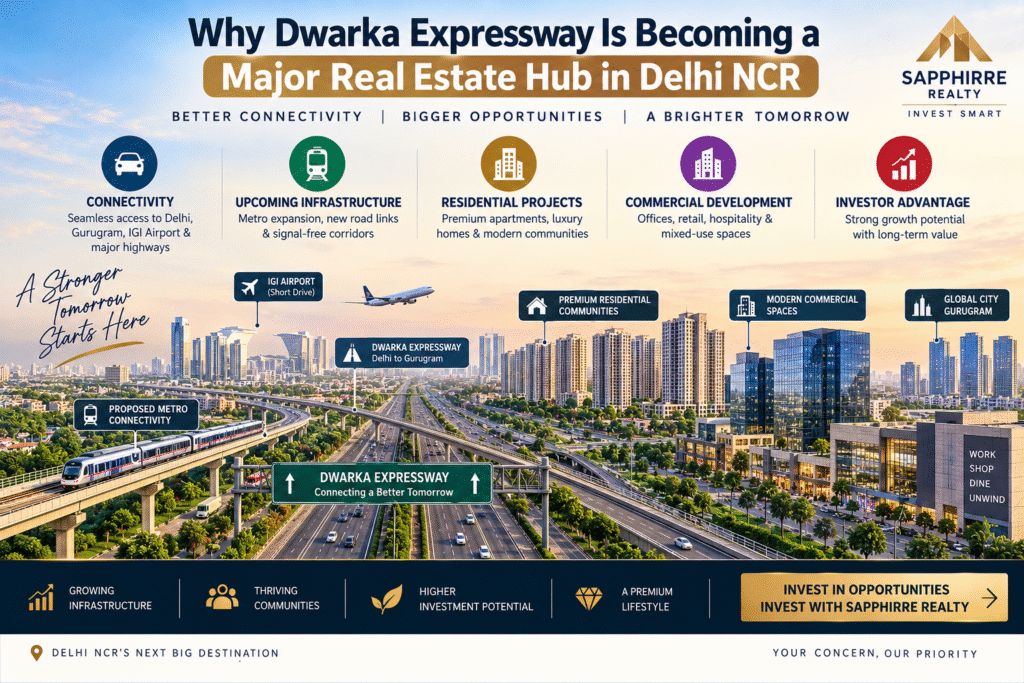
Why Dwarka Expressway Is Becoming a Major Real Estate Hub in Delhi NCR
The Dwarka Expressway has rapidly evolved from a long-awaited infrastructure corridor into one of the most closely watched real estate markets in Delhi-NCR.
Stretching between Delhi and Gurugram, the corridor combines improved road connectivity, proximity to IGI Airport, expanding residential communities, planned commercial development and new public-transport infrastructure.
In 2026, the story is no longer just about a future expressway. The corridor is increasingly about how completed infrastructure, new development and growing demand are reshaping Gurugram’s real estate landscape.
According to ANAROCK data reported in September 2026, residential prices along Dwarka Expressway had risen by 135% over five years, while the corridor has increasingly shifted toward larger and higher-ticket residential developments.
But does that mean every property along the expressway is a good investment?
Not necessarily.
For buyers and investors, the more important question is which location, project and property type fits their investment objective.
What Is Dwarka Expressway?
Dwarka Expressway, also known as Northern Peripheral Road (NH-248BB), connects the Dwarka area of Delhi with Kherki Daula in Gurugram.
The approximately 29-km, eight-lane corridor has become an important alternative route between Delhi and Gurugram. The full route has been operational since 2025, moving the corridor from an infrastructure-development story toward an operational connectivity corridor.
Its strategic location gives residents access to:
Delhi
IGI Airport
Gurugram’s employment hubs
NH-48
New Gurugram
Manesar
Central Peripheral Road
Southern Peripheral Road
This connectivity is one of the biggest reasons developers and homebuyers continue to focus on the corridor.
1. Connectivity Is the Biggest Growth Driver
Real estate development is closely connected with accessibility.
Dwarka Expressway provides an important east-west connection between Delhi and Gurugram and has improved access to the airport and major highways.
The corridor also connects with the wider Gurugram road network, including NH-48 and the Southern Peripheral Road (SPR).
In March 2026, GMDA floated a ₹755-crore tender for a 4.2-km signal-free elevated corridor between Vatika Chowk and NH-48, designed to strengthen connections between SPR, NH-48, the Gurugram-Sohna corridor and Dwarka Expressway.
Authorities are also working on upgrading links between Dwarka Expressway and developing sectors in New Gurugram to improve local connectivity.
Why this matters for real estate
Better connectivity can:
Reduce travel friction
Expand residential catchments
Improve access to employment hubs
Support commercial activity
Increase the attractiveness of previously peripheral sectors
However, investors should always distinguish between operational infrastructure and proposed infrastructure.
2. Metro Connectivity Could Add Another Layer of Growth
Road connectivity is not the only infrastructure story.
The proposed Gurugram Metro corridor includes a spur connecting the main Millennium City Centre–Cyber City corridor to Dwarka Expressway.
According to Gurugram Metro Rail Limited, the sanctioned metro corridor is approximately 28.5 km, with a 1.85-km spur to Dwarka Expressway. The planned network is intended to connect residential, institutional and commercial areas with employment hubs such as Udyog Vihar and Cyber City.
The Haryana government also stated in September 2026 that the Gurugram Metro project is being extended toward Dwarka Expressway.
If implemented as planned, improved public transport could further strengthen the corridor’s accessibility.
For investors, however, it is important to treat proposed metro infrastructure as a future factor rather than guaranteed immediate appreciation.
3. Residential Development Is Expanding Rapidly
One of the clearest signs of Dwarka Expressway’s transformation is the scale and variety of residential development.
The corridor now includes:
Luxury apartments
Premium residential towers
High-rise communities
Plotted developments
Residential floors
Mid-segment housing
Large-format luxury homes
The market is also moving toward higher-ticket housing.
ANAROCK data reported by Moneycontrol indicates that the corridor has increasingly attracted homes priced above ₹2.5 crore, with developers launching larger luxury configurations.
This represents a significant change from the earlier perception of Dwarka Expressway as primarily a future-growth or relatively affordable corridor.
4. Major Residential Projects Are Creating a New Housing Ecosystem
The presence of established developers can contribute to the development of an entire micro-market.
Projects along the corridor are spread across sectors including:
Sector 102
Sector 103
Sector 104
Sector 105
Sector 106
Sector 107
Sector 108
Sector 109
Sector 110
Sector 111
Sector 112
Sector 113
The Haryana RERA database, for example, contains registered projects along the corridor including Hero Homes Tower 8 in Sector 104, Sanctuary 105, Puri Aerosphere in Sector 111 and other projects.
This growing project ecosystem is important because a real estate corridor becomes more attractive when residential development is supported by schools, healthcare, retail, hospitality and everyday services.
5. Commercial Development Could Support Future Demand
Dwarka Expressway is not developing only as a residential corridor.
Commercial development is increasingly becoming part of the area’s long-term story.
The wider corridor is connected to important employment and commercial nodes, while planned development around Gurugram’s newer sectors is expected to increase the area’s employment and consumption base.
The proposed metro network specifically identifies the fast-developing Transit-Oriented Development (TOD) zone along Dwarka Expressway, connecting it with residential, institutional and commercial areas across Gurugram.
For investors, this matters because residential demand tends to be stronger when employment and commercial activity develop nearby.
6. Global City Adds a Major Employment Dimension
Another important development for the broader area is Global City Gurugram.
The project has been planned as a large mixed-use development incorporating office, residential and retail components.
The broader planning documentation for the Dwarka Expressway identifies Global City in Sector 36B as a major development associated with the corridor.
For the real estate market, the significance of large employment-oriented developments is that they can potentially create demand for:
Housing
Rental accommodation
Retail
Restaurants
Convenience stores
Office space
Hospitality
Supporting services
The actual impact, however, depends on the pace and scale at which development becomes operational.
7. Airport Proximity Strengthens the Corridor’s Appeal
Dwarka Expressway’s proximity to Indira Gandhi International Airport is another major advantage.
For frequent travellers, corporate professionals and businesses, airport accessibility can be an important factor when choosing a residential or commercial location.
This can be particularly relevant for premium housing, corporate accommodation, hospitality and commercial real estate.
But investors should look beyond the phrase “near airport.”
The actual travel time, access route and traffic conditions from a particular project should be evaluated rather than relying only on advertised distance.
8. Property Prices Have Changed Significantly
One of the most important developments in the Dwarka Expressway market has been the increase in property values.
According to ANAROCK data cited by Moneycontrol, residential prices along the corridor increased by approximately 135% over the five years through 2026.
This demonstrates how dramatically the market has changed.
But it also creates an important investment question:
Has the future growth already been priced into certain projects?
This is why investors should avoid making decisions solely based on historical appreciation.
A property that has already experienced substantial price growth may have a different future risk-return profile from a property entering an earlier stage of development.
9. Rental Potential Is Also Becoming Important
As residential communities become occupied and employment opportunities expand, rental demand can become an increasingly important component of the corridor’s real estate market.
Potential tenant groups include:
Corporate employees
Professionals working in Gurugram
Airport-related employees
Business executives
Families
Young professionals
Employees working around New Gurugram
Recent market reporting has highlighted strong rental movement along Dwarka Expressway. Business Today, citing Savills data, reported a 22% year-on-year increase in rental values during H1 2026.
However, rental performance can vary significantly from one project to another.
Factors such as:
Occupancy
Apartment configuration
Furnishing
Amenities
Distance from employment hubs
Road access
Maintenance charges
can all affect actual rental income.
10. Commercial Property: An Emerging Opportunity
As the residential population increases, commercial requirements generally expand around it.
Potential commercial opportunities around the wider Dwarka Expressway ecosystem include:
Retail
High-street shops
Convenience stores
Restaurants
Cafés
Supermarkets
Office
Managed offices
Small corporate offices
Business centres
Professional offices
Mixed-Use Development
Mixed-use developments can combine:
Residential + Retail + Offices + Hospitality
For commercial investors, however, location selection becomes even more important.
A shop in a high-footfall location can have a very different rental profile from a shop in an internal lane, even within the same broader sector.
Factors Investors Should Evaluate Before Buying
Dwarka Expressway’s growth story is attractive, but investors should conduct detailed due diligence.
1. Exact Location
Don’t simply buy because a property has a “Dwarka Expressway” address.
Check:
Distance from the expressway
Approach road
Sector location
Nearby development
Traffic conditions
Connectivity to NH-48 and SPR
2. Developer Track Record
Evaluate:
Previous project deliveries
Construction quality
Possession history
Customer reviews
Financial strength
Maintenance standards
3. RERA Status
Always verify the project’s RERA registration and approved details.
Haryana RERA’s database contains project-level information including registration numbers, promoter details, project locations and approval status.
4. Current Price vs. Future Potential
Don’t evaluate appreciation only from the historical price chart.
Compare:
Current price → Nearby comparable projects → Rental value → Supply pipeline → Infrastructure → Expected holding period
5. Ready-to-Move vs Under-Construction
Ready-to-Move
Advantages can include:
Immediate possession
Existing neighbourhood
Actual rental visibility
Lower construction uncertainty
Under-Construction
Potential advantages include:
Staggered payment schedules
Newer specifications
Potential development upside
But investors must also consider:
Construction risk
Delivery timelines
Financing costs
Future supply
6. Residential vs Commercial
For residential property, focus on:
End-user demand + rental demand + resale liquidity
For commercial property, focus on:
Footfall + tenant demand + frontage + lease terms + occupancy + surrounding catchment
What Could Make Dwarka Expressway Stronger Over the Long Term?
Several factors could influence the corridor’s future development:
Connectivity
Operational expressway and improving links with other major roads.
Metro
Proposed metro connectivity could strengthen public transport access.
Employment
Large commercial and employment developments can create housing demand.
Residential Population
More completed projects can create a larger local consumer base.
Commercial Ecosystem
Retail, offices, hospitality and services can make the corridor more self-sustaining.
Airport
Continued proximity and access to IGI Airport can support premium residential and commercial demand.
Risks Investors Should Not Ignore
Every emerging real estate corridor comes with risks.
1. High Entry Prices
Rapid appreciation can make certain projects expensive relative to neighbouring markets.
2. Supply
A large pipeline of new projects can increase competition between properties.
3. Infrastructure Timelines
Proposed infrastructure can face delays or changes.
4. Traffic
More residents and commercial activity can create congestion if local roads don’t expand at the same pace.
5. Project-Specific Risk
A strong location does not automatically make every project a good investment.
6. Rental Yield
Capital appreciation and rental yield are different metrics. Investors should calculate actual rental yield after maintenance, vacancy and other costs.
Why Dwarka Expressway Is Becoming a Major Real Estate Hub
The transformation of Dwarka Expressway is being driven by multiple factors rather than a single infrastructure project.
The corridor now combines:
Expressway connectivity + airport access + residential development + planned metro connectivity + commercial growth + employment hubs + improving local infrastructure.
The fact that new residential projects continue to receive RERA registrations also indicates continued developer activity along the corridor.
For homebuyers, this creates more choices.
For investors, it creates more opportunities—but also makes project selection and due diligence more important.
Final Thoughts
Dwarka Expressway has moved into a new phase of its development.
It is no longer simply a proposed connectivity project. With the expressway operational, residential communities expanding and additional road and metro infrastructure being planned, the corridor is becoming an increasingly integrated part of the Gurugram real estate market.
However, investors should not treat the entire expressway as one uniform market.
Sector, project, developer, entry price, possession status, connectivity, rental demand and future supply can all make a significant difference.
The right approach is to evaluate the specific property rather than investing only in the location story.
Looking to Explore Property on Dwarka Expressway?
Sapphirre Realty helps homebuyers and investors explore residential and commercial real estate opportunities across Gurugram and Delhi-NCR.
Your Concern, Our Priority.
This article is for educational and informational purposes only. Real estate prices, infrastructure timelines and rental conditions can change. Investors should independently verify RERA records, approvals, project documents, pricing and other relevant information before making a purchase decision.