

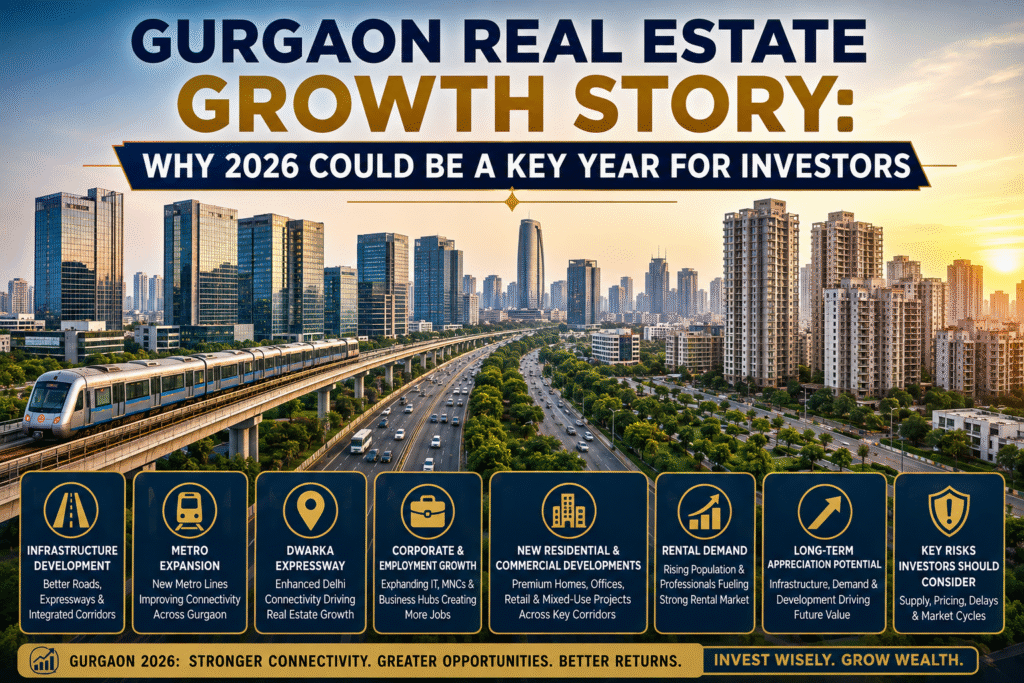
🚀 Gurgaon Real Estate Growth Story: Why 2026 Could Be a Key Year for Investors
Gurgaon, officially Gurugram, has transformed from a satellite city of Delhi into one of India’s most important corporate, residential and commercial real estate destinations.
In 2026, this transformation is entering another important phase. Major infrastructure projects are improving connectivity, the city’s office market continues to expand, new residential and commercial developments are coming up across multiple corridors, and demand for quality housing remains closely linked to Gurgaon’s growing employment base.
For investors searching for Gurgaon real estate 2026 opportunities, the bigger question is no longer simply “Will Gurgaon grow?”
The more important question is:
Which locations and property types are best positioned to benefit from the next phase of Gurgaon’s growth?
Let’s understand the key factors shaping the Gurgaon property market 2026 and what they could mean for investors.
🏙️ Why Gurgaon Continues to Attract Real Estate Investment
Gurgaon’s real estate story is supported by several interconnected factors:
Strategic location next to Delhi
Proximity to IGI Airport
Large corporate and employment ecosystem
Expanding road infrastructure
Metro connectivity
Growing residential population
New commercial districts
Premium housing demand
Increasing institutional investment
The city’s office market has crossed 100 million sq. ft. of total office stock in 2026, making Gurugram the largest office market in North India, according to CBRE. Between 2021 and Q1 2026, the city recorded about 40 million sq. ft. of office leasing and added around 21 million sq. ft. of new office supply. CBRE expects office stock to reach approximately 120–125 million sq. ft. by 2030.
This matters for residential investors because a growing office ecosystem creates employment, and employment creates demand for housing, rentals, retail, hospitality and supporting services.
🛣️ 1. Infrastructure Development: The Biggest Growth Catalyst
Infrastructure is one of the strongest drivers of real estate appreciation.
When roads, expressways, metro lines and public infrastructure improve, previously underdeveloped locations can become more accessible and attractive to both residents and businesses.
Gurgaon is currently experiencing significant infrastructure development across multiple corridors.
Key areas include:
Dwarka Expressway
Southern Peripheral Road (SPR)
Golf Course Extension Road
New Gurgaon
Sohna Road
Sector 70–80 belt
Manesar and surrounding areas
For investors, the important point is that infrastructure can influence both capital appreciation and rental demand.
However, investors should distinguish between:
Completed infrastructure and announced infrastructure.
A project that is already operational carries a different investment risk from one that is still awaiting approvals, tenders or construction.
🚗 2. Dwarka Expressway: A New Connectivity Backbone
Dwarka Expressway has become one of the most significant infrastructure developments influencing the Gurgaon property market 2026.
The Haryana section of the eight-lane expressway was inaugurated in March 2024. The 19-km Haryana section was built at a cost of around ₹4,100 crore and was designed to improve traffic flow and connectivity between Delhi and Gurugram.
The corridor has strengthened connectivity between:
Delhi → Dwarka → Airport region → Gurgaon → Kherki Daula
This has helped transform sectors along the expressway into important residential and commercial development zones.
Why does this matter for property investors?
Improved connectivity can make a location more attractive to:
Homebuyers
Corporate employees
Investors
Retail businesses
Commercial operators
Developers
This creates the possibility of a broader real estate ecosystem developing around the corridor.
But investors should avoid assuming that every property near an expressway will automatically appreciate.
The exact sector, project location, access road, developer quality and surrounding infrastructure still matter.
🚇 3. Metro Expansion Could Reshape Gurgaon’s Real Estate Map
Metro connectivity is another major factor that could influence the future of Gurgaon real estate.
The approved Gurugram Metro corridor from Millennium City Centre to Cyber City, with a spur toward Dwarka Expressway, covers approximately 28.5 km and 27 elevated stations. The official project information says the corridor is intended to connect old and new Gurugram and integrate residential, institutional, commercial and industrial areas.
The proposed alignment passes through important areas including:
Sector 45
Cyber Park
Sector 47
Subhash Chowk
Sector 48
Sector 72A
Hero Honda Chowk
Udyog Vihar
Sector 37
Basai
Old Gurgaon
Palam Vihar
Udyog Vihar
Cyber City
As of mid-2026, construction is underway. Parliament was informed that around 3.3% physical progress had been achieved through June 2026.
Potential real estate impact
Metro connectivity can potentially improve:
Accessibility → Commuting → Tenant demand → End-user demand → Property attractiveness
Properties within convenient reach of major stations may become increasingly attractive as the network develops.
However, investors should remember:
Metro impact is usually a long-term story, not an overnight price trigger.
The actual benefit depends on station accessibility, pedestrian infrastructure, surrounding development and eventual operational connectivity.
🏢 4. Corporate and Employment Growth
Perhaps the most important long-term factor behind Gurgaon’s real estate demand is its corporate ecosystem.
Gurgaon is home to major:
IT companies
Multinational corporations
Financial services firms
Consulting companies
Startups
Global capability centres
Business parks
Retail and hospitality businesses
The city’s office stock crossing 100 million sq. ft. in 2026 demonstrates the scale of this commercial ecosystem. CBRE expects the market to continue expanding toward roughly 120–125 million sq. ft. by 2030.
This creates a powerful relationship:
More Offices
↓
More Jobs
↓
More Professionals
↓
More Housing Demand
↓
More Rental Demand
↓
Greater Demand for Retail & Services
This is one of the fundamental reasons Gurgaon remains attractive for real estate investors.
🏗️ 5. New Residential and Commercial Developments
Gurgaon’s skyline is continuing to expand.
New residential projects are emerging across corridors such as:
Dwarka Expressway
Premium and mid-premium housing developments are expanding across multiple sectors.
Golf Course Extension Road
A mature premium residential ecosystem continues to attract high-end buyers.
SPR
A major growth corridor with residential and commercial development.
New Gurgaon
A large residential market with multiple established and upcoming projects.
Sohna Road
A continuing residential and mixed-use development zone.
Sector 70–80
A strategically located belt benefiting from connectivity to multiple growth corridors.
At the commercial end, Gurgaon continues to see development of:
High-street retail
Office spaces
SCO properties
Mixed-use developments
Shopping centres
Food & beverage destinations
For investors, this creates a wide range of choices—but also makes project selection more important than ever.
🏠 6. Rental Demand: Why Employment Matters
Rental demand is directly connected to population and employment growth.
Gurgaon attracts professionals from across India because of its corporate ecosystem.
Employees working around:
Cyber City
Golf Course Road
Golf Course Extension
Udyog Vihar
Sohna Road
SPR
NH-48
New Gurgaon
often prefer housing with convenient access to their workplaces.
This creates rental demand for:
1 BHK apartments
2 BHK apartments
3 BHK apartments
Luxury apartments
Builder floors
Serviced apartments
Co-living properties
For rental-focused investors, proximity to employment hubs and transportation can be more important than simply buying in a fast-growing sector.
📈 7. Gurgaon Property Price: What Could Drive Future Appreciation?
When investors search for Gurgaon property price trends, it is important to understand that Gurgaon does not behave like a single market.
Property prices can vary dramatically between micro-markets.
For example:
Golf Course Road ≠ Dwarka Expressway ≠ New Gurgaon ≠ Sohna Road
Each corridor has different:
Entry prices
Supply levels
Infrastructure
Rental demand
Developer profile
Buyer demographics
Development timelines
Recent market reporting has highlighted continued premiumisation in Gurgaon. Ultra-luxury transactions, including a reported ₹271 crore penthouse purchase at DLF’s The Dahlias in August 2026, demonstrate the depth of demand at the very top end of the market.
But investors should not interpret luxury transactions as representative of the entire market.
For mainstream investors, the more important question is:
Can the location continue attracting residents and businesses at a sustainable rate?
💰 8. Long-Term Appreciation Potential
Real estate appreciation is generally strongest when several factors come together.
1. Infrastructure
Better roads and public transportation improve accessibility.
2. Employment
More jobs create more housing demand.
3. Limited High-Quality Supply
Locations with strong demand and controlled quality supply can perform better.
4. Social Infrastructure
Schools, hospitals, retail and entertainment make a location more liveable.
5. Connectivity
Easy access to Delhi, airport, highways and business districts adds value.
6. Population Growth
More residents create demand for homes, rentals and commercial services.
Gurgaon’s growth story benefits from the combination of many of these factors.
This is why investors should think about 5–10 year potential, rather than trying to predict the next three or six months of property prices.
📍 Which Gurgaon Corridors Could Benefit From the Growth Story?
🛣️ Dwarka Expressway
Investment theme: Infrastructure + connectivity
Potentially suitable for investors looking at long-term development and Delhi-airport connectivity.
🏙️ Golf Course Extension Road
Investment theme: Premium residential + established demand
More suitable for investors prioritising established infrastructure, premium housing and rental demand.
🚀 SPR
Investment theme: Growth + strategic connectivity
An important corridor connecting several major Gurgaon markets.
🏘️ New Gurgaon
Investment theme: Large-scale residential development
Can appeal to first-time and mid-budget investors looking for relatively accessible entry points.
🌆 Sohna Road
Investment theme: Value + long-term development
A mature corridor that continues to evolve with residential and commercial development.
🏢 Sector 70–80 Belt
Investment theme: Strategic location + connectivity
An interesting middle ground for investors seeking access to multiple Gurgaon growth corridors.
⚠️ 9. Key Risks Investors Should Consider
Gurgaon’s growth story is attractive, but no real estate investment is risk-free.
1. Over-Supply
Rapid development can create periods where supply exceeds immediate demand.
Investors should check:
How many competing projects are coming up nearby?
2. High Property Prices
Rapid appreciation can make certain properties expensive relative to their rental income.
A high purchase price can reduce rental yield even if the property is in an excellent location.
3. Infrastructure Delays
An announced road, metro station or infrastructure project is not the same as an operational one.
Always check the actual construction and implementation status.
4. Developer Risk
Investors should examine:
Track record
Delivery history
RERA information
Construction quality
Financial credibility
Existing project performance
5. Liquidity Risk
A property may appreciate on paper but still take time to sell.
Liquidity depends on:
Location
Price
Property type
Developer
Market conditions
Buyer demand
6. Rental Vacancy
Rental income is not guaranteed.
A property can remain vacant between tenants, especially if the rent is unrealistic compared with competing properties.
7. Water, Drainage and Local Infrastructure
City-level growth does not mean every sector has equally developed civic infrastructure.
For example, recurring waterlogging has recently been reported around the Sector 102–102A road near Dwarka Expressway, highlighting why investors should inspect micro-level infrastructure rather than relying only on a corridor’s overall reputation.
🧠 How Should Investors Approach Gurgaon in 2026?
Instead of asking:
“Which Gurgaon property will give the highest ROI?”
ask these five questions:
1. Where will people want to live?
Look at employment, schools, hospitals, retail and connectivity.
2. Where will businesses want to operate?
This is particularly important for commercial investments.
3. What infrastructure is already operational?
Don’t base your entire investment thesis on future promises.
4. Is the property correctly priced?
A great location can still be a poor investment if you overpay.
5. What is my exit strategy?
Know whether you plan to:
Rent → Hold → Resell → Upgrade → Reinvest
before purchasing.
🔮 The Future of Gurgaon Real Estate
The future of Gurgaon real estate is likely to be increasingly corridor-driven.
Instead of one central Gurgaon market, the city is developing multiple interconnected real estate hubs:
Delhi/Dwarka
↓
Dwarka Expressway
↓
New Gurgaon
↓
SPR
↓
Golf Course Extension
↓
Sohna
↓
Manesar
At the same time, established commercial areas such as Cyber City and Udyog Vihar continue to anchor the employment ecosystem.
The planned metro network is also designed to connect old and new Gurugram and link residential, commercial and industrial areas, potentially strengthening this interconnected urban structure.
🏆 Why 2026 Could Be a Key Year for Gurgaon Investors
2026 is significant because several long-term growth factors are coming together:
🚇 Metro development
New connectivity is being built across previously underserved parts of the city.
🛣️ Expressway infrastructure
Dwarka Expressway is already operational, changing Delhi-Gurgaon connectivity.
🏢 Corporate expansion
Gurgaon’s office market has crossed 100 million sq. ft.
🏠 Residential demand
A large employment base continues to support housing requirements.
🏗️ New development
Multiple corridors are seeing residential and commercial expansion.
📈 Premiumisation
Gurgaon continues to attract demand at the luxury end of the market.
Together, these factors support a compelling long-term investment narrative.
But investors should remember:
Infrastructure creates opportunity. Demand creates value. The right property creates returns.
📌 Final Takeaway
The Gurgaon real estate 2026 story is much bigger than rising property prices.
It is a story of:
Infrastructure + Employment + Connectivity + Urbanisation + Residential Demand + Commercial Growth
The city’s office market has crossed the 100-million-sq.-ft. milestone, Dwarka Expressway has become a major connectivity asset, and the new Gurugram Metro corridor is under construction. These developments could continue reshaping the city’s real estate landscape over the coming years.
For investors, however, the goal should not be to chase the hottest location.
Instead:
Choose the right micro-market.
Choose the right developer.
Buy at a sensible valuation.
Understand rental demand.
Check infrastructure status.
Plan your exit.
If these fundamentals align, Gurgaon can continue to offer attractive Gurgaon investment opportunities for investors with a medium- to long-term horizon.
Frequently Asked Questions
Is Gurgaon a good place to invest in real estate in 2026?
Gurgaon continues to have strong structural fundamentals, particularly its corporate ecosystem, infrastructure development and residential demand. However, returns depend on the specific location, project, entry price and investment horizon.
Which areas in Gurgaon have the highest growth potential?
Key corridors to research include Dwarka Expressway, SPR, Golf Course Extension Road, New Gurgaon, Sohna Road and the Sector 70–80 belt. Each has a different risk-return profile.
Will the metro increase Gurgaon property prices?
Improved metro connectivity can increase the attractiveness of properties near stations by improving accessibility and potentially strengthening rental and end-user demand. However, appreciation is not guaranteed and depends on broader market conditions.
Is Dwarka Expressway good for investment in 2026?
It can be attractive for long-term investors because the expressway is operational and has improved Delhi-Gurgaon connectivity. However, investors should evaluate individual sectors and projects rather than buying solely because of the corridor’s name.
What is driving Gurgaon property prices?
Major factors include infrastructure, employment growth, office expansion, residential demand, connectivity, land availability, construction costs and buyer sentiment.
What should I check before investing in Gurgaon?
Check the developer’s track record, RERA registration, title and approvals, exact site connectivity, nearby infrastructure, competing supply, rental demand, total acquisition cost and your expected exit strategy.
SEO Keywords: Gurgaon real estate 2026, Gurgaon property market 2026, Gurgaon property price, future of Gurgaon real estate, Gurgaon investment opportunities
Disclaimer: This article is for general informational and educational purposes only and should not be treated as financial or investment advice. Real estate returns are not guaranteed. Investors should independently verify project approvals, RERA registration, title, pricing, construction status, infrastructure timelines, taxes and other applicable costs before making an investment decision.